The core idea: look at the dealer's card first
The dealer must draw until 17. With a 2, 3, 4, 5 or 6 showing, they start weak and bust often (up to 42% of the time with a 6). With 7 through ace, they usually end up on 17 or better.
Hence the two big ideas: against a weak card, take few risks and double whenever you can; against a strong card, improve your hand even when it's risky. Played without mistakes, basic strategy cuts the house edge to about 0.5%.
The full chart
Rules: 4 to 8 decks, dealer stands on soft 17, double after split, late surrender. Rows: your hand. Columns: dealer upcard.
Hard hands (no ace counted as 11)
| Hand | 2 | 3 | 4 | 5 | 6 | 7 | 8 | 9 | 10 | A |
|---|---|---|---|---|---|---|---|---|---|---|
| 17+ | S | S | S | S | S | S | S | S | S | S |
| 16 | S | S | S | S | S | H | H | Rh | Rh | Rh |
| 15 | S | S | S | S | S | H | H | H | Rh | H |
| 14 | S | S | S | S | S | H | H | H | H | H |
| 13 | S | S | S | S | S | H | H | H | H | H |
| 12 | H | H | S | S | S | H | H | H | H | H |
| 11 | D | D | D | D | D | D | D | D | D | H |
| 10 | D | D | D | D | D | D | D | D | H | H |
| 9 | H | D | D | D | D | H | H | H | H | H |
| 8 | H | H | H | H | H | H | H | H | H | H |
| 7 | H | H | H | H | H | H | H | H | H | H |
| 6 | H | H | H | H | H | H | H | H | H | H |
| 5 | H | H | H | H | H | H | H | H | H | H |
- 12 to 16 vs 2 to 6: stand (except 12 vs 2 and 3). Let the dealer take the risk.
- 12 to 16 vs 7 through ace: hit. Standing loses about three times out of four.
- 11: double against everything but an ace. 10: double vs 2 to 9. 9: double vs 3 to 6.
Soft hands (with an ace counted as 11)
| Hand | 2 | 3 | 4 | 5 | 6 | 7 | 8 | 9 | 10 | A |
|---|---|---|---|---|---|---|---|---|---|---|
| A,9 | S | S | S | S | S | S | S | S | S | S |
| A,8 | S | S | S | S | S | S | S | S | S | S |
| A,7 | S | Ds | Ds | Ds | Ds | S | S | H | H | H |
| A,6 | H | D | D | D | D | H | H | H | H | H |
| A,5 | H | H | D | D | D | H | H | H | H | H |
| A,4 | H | H | D | D | D | H | H | H | H | H |
| A,3 | H | H | H | D | D | H | H | H | H | H |
| A,2 | H | H | H | D | D | H | H | H | H | H |
- A soft hand can't bust with one card, so hitting and doubling are cheap.
- A,7 (soft 18): double vs 3 to 6, stand vs 2, 7 and 8, hit vs 9, 10 and ace.
- A,8 and A,9: always stand.
Pairs
| Hand | 2 | 3 | 4 | 5 | 6 | 7 | 8 | 9 | 10 | A |
|---|---|---|---|---|---|---|---|---|---|---|
| A,A | P | P | P | P | P | P | P | P | P | P |
| 10,10 | S | S | S | S | S | S | S | S | S | S |
| 9,9 | P | P | P | P | P | S | P | P | S | S |
| 8,8 | P | P | P | P | P | P | P | P | P | P |
| 7,7 | P | P | P | P | P | P | H | H | H | H |
| 6,6 | P | P | P | P | P | H | H | H | H | H |
| 5,5 | D | D | D | D | D | D | D | D | H | H |
| 4,4 | H | H | H | P | P | H | H | H | H | H |
| 3,3 | P | P | P | P | P | P | H | H | H | H |
| 2,2 | P | P | P | P | P | P | H | H | H | H |
- Always split aces and eights. Never split tens or fives.
- 9,9: split, except against 7, 10 and ace (stand).
- 2,2 / 3,3 / 7,7: split vs 2 to 7. 6,6: vs 2 to 6. 4,4: only vs 5 and 6.
When to surrender
If the table offers late surrender: give up 16 vs 9, 10 and ace, and 15 vs 10. Getting half your bet back costs less than playing those hands out.
Why you should decline insurance
Insurance pays 2 to 1 when the dealer has a ten under their ace. In a six-deck shoe that happens about 31% of the time; you'd need 33.3% to break even. So insurance loses about 7% of what you put on it. The exception: card counters take it at a Hi-Lo true count of +3 or higher (see card counting).
How to memorize it fast
- Learn hard hands first: they cover roughly 75% of the situations you'll face.
- Add pairs: two absolute rules (aces and eights) and a few cases.
- Finish with soft hands, the ones people get wrong most often.
- Drill against the clock until you answer without hesitating.
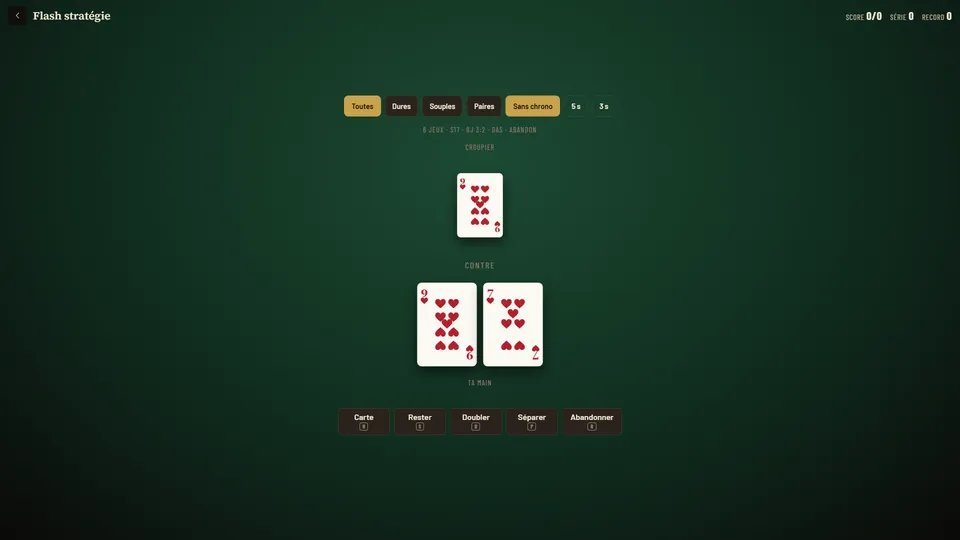
Flash drill: one hand, one dealer card, find the right play.
Start the drillDifferent rules at your table (H17, single deck, European no-hole-card)? The chart inside the game recalculates itself from your settings.